
How Pipe Types Affect the Way You Repair a Leak
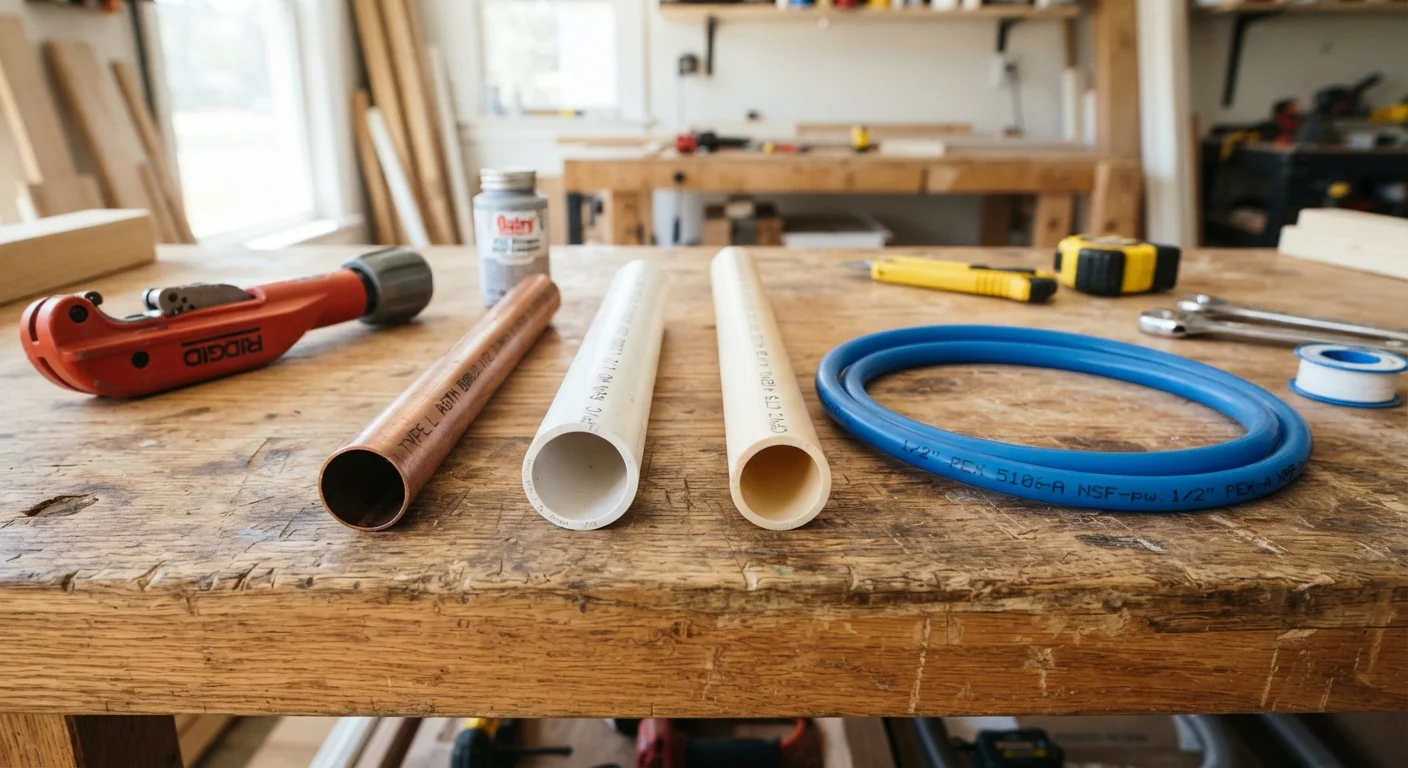
Photo credit: readerspanel.com
In this article
Copper, PVC, CPVC, and PEX all require different repair approaches. Learn the key differences before you attempt any plumbing patch.
Key Takeaways
- Copper pipes are repaired with soldering or compression fittings; open flame work requires caution and often a licensed plumber.
- PVC is cold-water and drain pipe only; repairs use solvent cement and slip couplings without heat.
- CPVC handles hot water and uses its own solvent cement, which is not interchangeable with PVC cement.
- PEX is repaired with crimp or push-fit fittings and requires no glue or flame.
- Misidentifying your pipe material before starting a repair is the most common cause of a failed patch.
Why the pipe material changes everything
A repair that takes twenty minutes on PEX can take an hour on copper and fail entirely if the wrong cement is applied to CPVC. Before touching a leaking pipe, identify the material. Run your hand along the pipe: copper is hard, reddish-brown metal; PVC is rigid, white or gray plastic; CPVC is rigid, cream or light yellow plastic; PEX is flexible, often color-coded red for hot, blue for cold, and white for either.
The material determines which fittings seal correctly, whether heat or solvents are involved, and whether the pipe carries hot water, cold water, or drainage. Getting this wrong means a second leak, a failed inspection, or a fitting that separates under pressure.
Copper pipe repairs
Copper is found in homes built before the 1990s and remains common in municipal water systems. A pinhole leak or split section typically calls for one of two approaches: a soldered (sweat) repair or a compression fitting.
Soldering requires cutting out the damaged section, cleaning the pipe ends with emery cloth, applying flux, and heating the joint with a torch until solder flows into the gap. This is effective but carries real fire risk when the pipe runs near wood framing or insulation. Many local codes require a licensed plumber for torch work inside wall cavities. If you are not experienced with a torch, a compression fitting or a push-fit fitting designed for copper is a safer choice: both slide over the pipe ends and seal without flame.
Always shut off the main water supply and drain the line before cutting copper. Residual water in the pipe prevents solder from bonding and can cause steam burns.
PVC pipe repairs
PVC (polyvinyl chloride) is white or gray, rigid, and found in drain, waste, and vent lines as well as cold-water supply in some installations. It cannot handle hot water; sustained heat above roughly 140 degrees Fahrenheit causes PVC to soften and deform.
Repairs use a slip coupling, a short fitting with no internal stop that slides over both pipe ends. Cut out the cracked section with a hacksaw or pipe cutter, deburr the cut edges, apply PVC primer to both the pipe ends and the inside of the coupling, then apply PVC solvent cement and seat the fitting quickly. The cement creates a chemical weld, not a mechanical seal, so alignment matters before the bond sets.
Do not use PVC cement on CPVC or vice versa. The two formulas are not compatible and the joint will fail.
| Copper | PVC | CPVC | PEX | |
|---|---|---|---|---|
| Common use | Hot and cold supply | Drain/vent, cold supply | Hot and cold supply | Hot and cold supply |
| Repair method | Solder or compression fitting | Solvent cement slip coupling | CPVC solvent cement slip coupling | Push-fit or crimp fitting |
| Heat involved | Yes (soldering) | No | No | No |
| Handles hot water | Yes | No | Yes | Yes |
| DIY difficulty | Moderate to hard | Moderate | Moderate | Easy to moderate |
| Special tools needed | Torch or compression tool | Pipe cutter, primer | Pipe cutter, primer | PEX cutter, crimp tool or push-fit |
CPVC pipe repairs
CPVC (chlorinated polyvinyl chloride) is cream or light yellow and is rated for hot-water distribution lines, typically up to 180 degrees Fahrenheit. It looks similar to PVC but is chemically different, which is why it requires its own solvent cement marked for CPVC use.
The repair process mirrors PVC: cut out the damaged section, use CPVC primer, apply CPVC cement, and insert a slip coupling. Because CPVC is more brittle than PVC, especially in older installations, avoid over-tightening mechanical fittings and handle cut sections gently to prevent cracking the surrounding pipe.
Check the pipe markings printed along its length. They will say "CPVC" and list a pressure rating. That marking is the fastest confirmation of material before you buy fittings.
PEX pipe repairs
PEX (cross-linked polyethylene) is flexible plastic tubing installed widely in homes built or repiped after the mid-1990s. Its flexibility lets it run through walls and floors without as many fittings as rigid pipe, and it resists freeze damage better than copper or rigid plastic.
Repairs require no glue and no flame. Cut out the damaged section with a PEX cutter or sharp utility knife, leaving clean square ends. Then connect a push-fit fitting or use a crimp ring with the appropriately sized crimp tool. Push-fit fittings are accessible to most homeowners and work on PEX-A, PEX-B, and PEX-C types. Crimp fittings are more secure for permanent repairs but require a calibrated crimp tool.
Confirm your PEX type before buying fittings. PEX-A uses an expansion fitting system that is not compatible with the crimp rings used on PEX-B and PEX-C. The pipe type is usually printed on the tubing itself.

Author
Home & Garden Editorial Team
Home & Garden Editorial Team is the collective byline for our editorial team and contributor network. Articles published under this byline or an editorial pen name are researched, written, and reviewed according to our editorial standards for clarity, consistency, and independence before publication.
View all articles →