
Cat Nutrition Labels Decoded
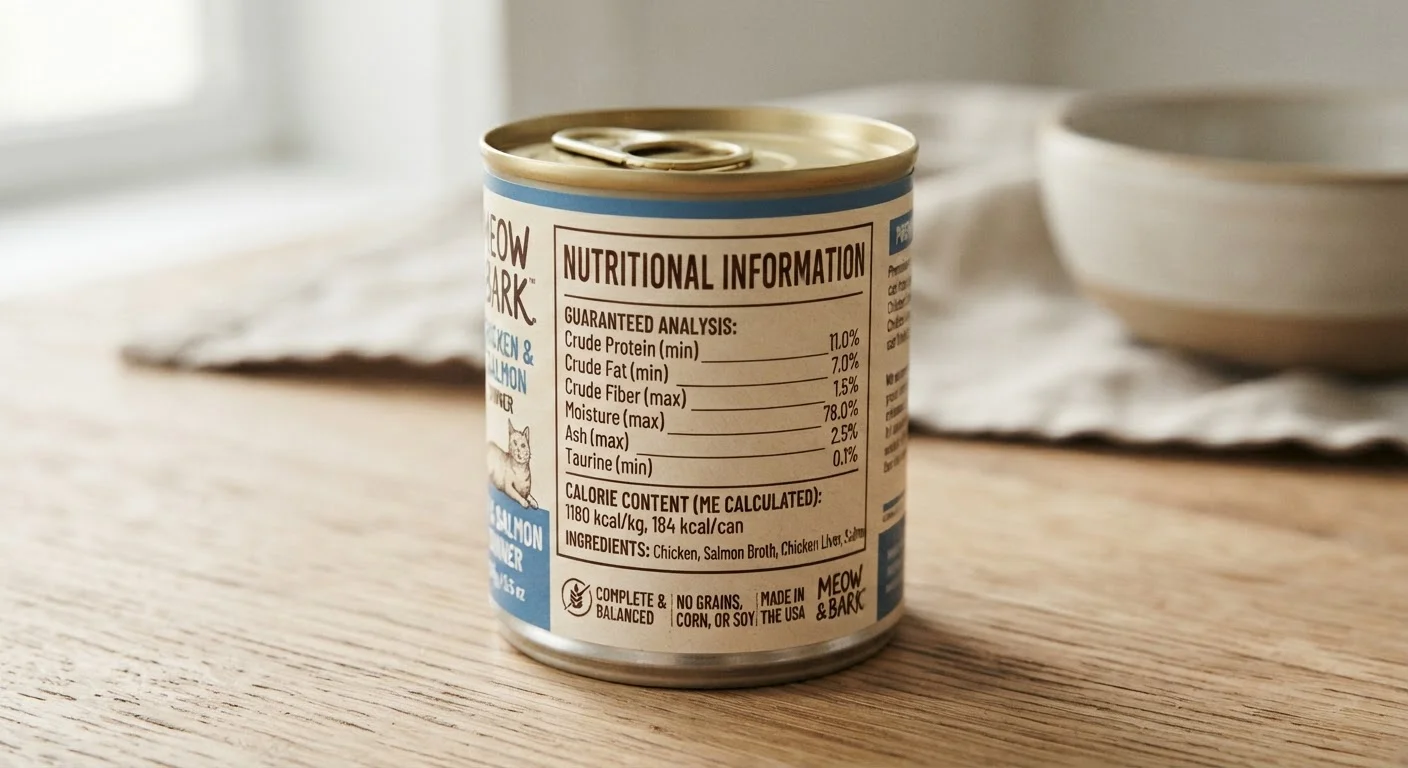
Photo credit: readerspanel.com
In this article
Moisture content, crude protein, ash, and more: learn what pet food label terms actually mean so you can make informed choices for your cat.
Why cat food labels are worth reading carefully
A cat food label contains more useful information than most owners realize, and also more marketing language than most realize. The two are not always easy to separate. Federal regulations from the AAFCO and the FDA govern what must appear on a pet food label, but they do not govern every claim a manufacturer chooses to make.
This article focuses on the regulated sections: the ingredient list, the guaranteed analysis, the nutritional adequacy statement, and the feeding directions. These four sections give you the most reliable information for evaluating whether a food suits your cat.
For a broader look at how label claims work across consumer products, see what product labels actually tell you.
Crude protein
A measure of total nitrogen in a food, calculated using the Kjeldahl method. It estimates protein content but does not distinguish between high-quality and low-quality protein sources.
Dry matter basis
A way of expressing nutrient content after all moisture is removed. It allows fair comparison between wet and dry foods, which differ widely in water content.
AAFCO
The Association of American Feed Control Officials. A voluntary organization that sets model regulations and nutrient profiles used by most U.S. states to govern pet food labeling and formulation.
Nutritional adequacy statement
A required label statement indicating whether a pet food is complete and balanced for a specific life stage, and which method (formulation or feeding trial) was used to establish that.
Ingredient splitting
A labeling practice where one ingredient is listed in multiple forms to reduce its apparent prominence on the ingredient list, even though the combined total may be significant.
Ash
The inorganic mineral residue that remains after food is combusted in a laboratory. It reflects the total mineral content of the food, including calcium, phosphorus, and magnesium.
The guaranteed analysis panel
The guaranteed analysis lists minimum or maximum percentages for four nutrients: crude protein (minimum), crude fat (minimum), crude fiber (maximum), and moisture (maximum). The word 'crude' refers to the method of measurement, not the quality of the ingredient.
One common source of confusion is comparing wet and dry foods on an as-fed basis. A wet food might show 10% crude protein, while a dry food shows 30%. The wet food is not automatically lower in protein: once you account for moisture (roughly 75% to 80% in wet food versus 10% in dry), the dry-matter protein values may be similar. To compare them fairly, you need to convert both to a dry-matter basis by dividing each nutrient percentage by the percentage of dry matter (100 minus moisture).
| Moisture in wet cat food | Roughly 75-80% (AAFCO Pet Food Labeling Guide) |
| Moisture in dry cat food | Roughly 6-10% (AAFCO Pet Food Labeling Guide) |
| Required guaranteed analysis nutrients | Crude protein, crude fat, crude fiber, moisture (FDA pet food labeling regulations) |
| AAFCO nutritional adequacy methods | Formulation or feeding trial (AAFCO Official Publication) |
| Life stages recognized by AAFCO | Kitten, adult maintenance, all life stages (AAFCO Pet Food Labeling Guide) |
Ash, which is not always listed in the guaranteed analysis, is the mineral residue left after food is burned. Some owners of cats with urinary issues watch ash content, though current veterinary guidance focuses more on specific minerals like magnesium and phosphorus than on total ash. Discuss this with your veterinarian if your cat has a history of urinary tract problems.
Reading the ingredient list
Ingredients are listed by pre-cooking weight, heaviest first. This means a meat listed first may weigh less after moisture is removed during processing than a grain listed third. 'Chicken' and 'chicken meal' are different: chicken meal has already had most moisture removed, so it delivers more protein per pound of ingredient.
Ingredient splitting is a practice where a manufacturer lists one ingredient (say, corn) in several forms (corn flour, corn gluten meal, ground corn) to push each one lower on the list. The combined amount of that ingredient may be higher than a single entry would suggest.
There is no regulatory definition for 'natural' or 'holistic' on pet food labels. 'Human-grade' has a specific legal meaning only if the manufacturer can demonstrate the food was manufactured to human food standards, which is rare. For more on how these kinds of claims work generally, nutrition claims on packaging is a useful companion read.
The AAFCO nutritional adequacy statement
This statement is one of the most meaningful lines on any cat food label. It tells you whether the food is complete and balanced, and for which life stage. The two recognized methods are formulation (the recipe meets AAFCO nutrient profiles on paper) and feeding trials (the food was actually fed to cats and met defined standards).
Life stage designations matter. 'All life stages' means the food meets the higher nutrient requirements of kittens and pregnant or nursing cats, so it is appropriate for adults as well. 'Adult maintenance' means it was formulated only for adult cats and should not be the sole diet for kittens. A food labeled 'for supplemental feeding only' or 'intended for intermittent or supplemental use' is not a complete diet.
If a food carries no nutritional adequacy statement at all, it is not formulated to meet complete nutritional needs. Feeding it as a primary diet over time can lead to deficiencies. For context on how feeding choices fit into broader daily care, see building a daily routine your cat will actually appreciate.
This article is for general informational purposes only and is not veterinary or medical advice. Always consult a licensed veterinarian before making significant changes to your cat's diet, especially if your cat has a health condition.

Author
Pets & Animals Editorial Team
Pets & Animals Editorial Team is the collective byline for our editorial team and contributor network. Articles published under this byline or an editorial pen name are researched, written, and reviewed according to our editorial standards for clarity, consistency, and independence before publication.
View all articles →