
Hands-Free Is Not Risk-Free: The Cognitive Load of Phone Calls While Driving
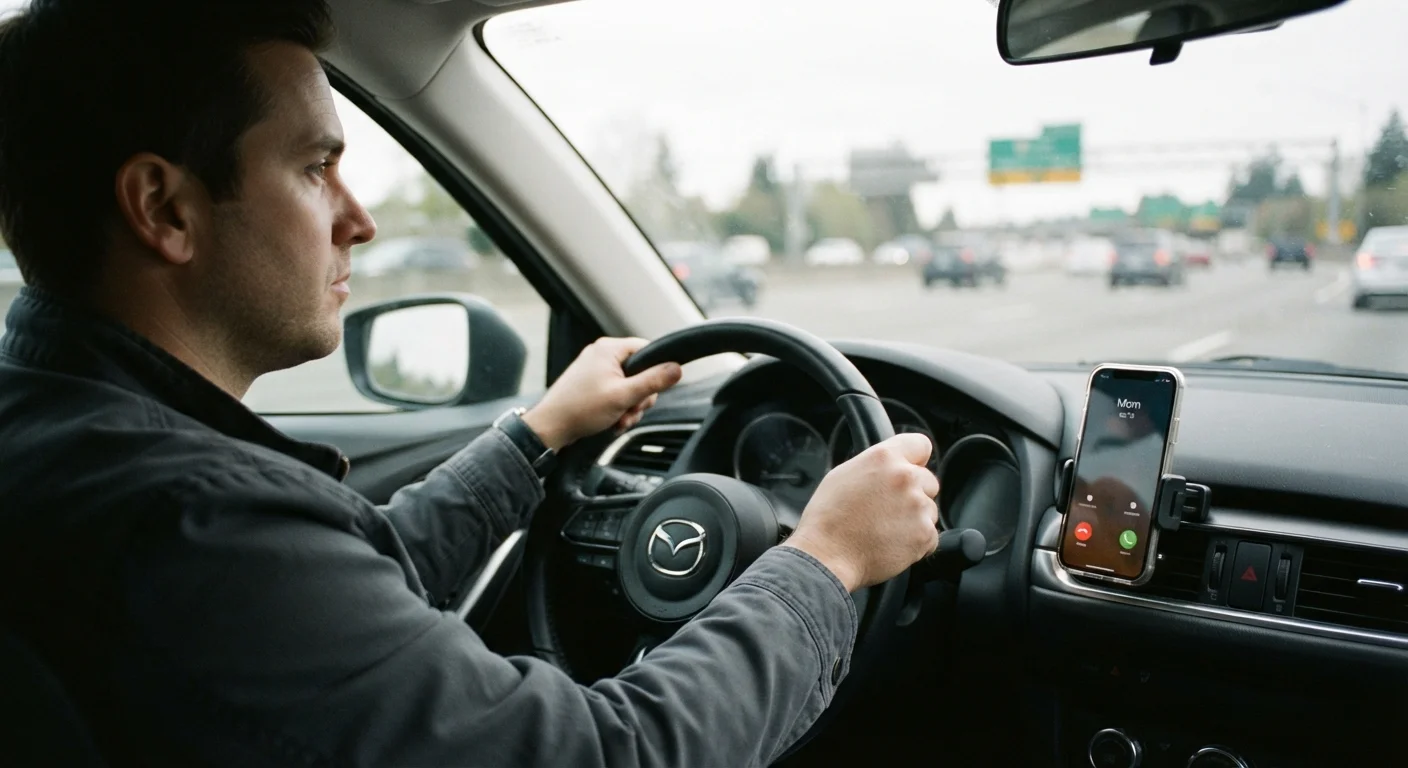
Photo credit: readerspanel.com
Research consistently shows hands-free calls still impair driving. Understand why the distraction is mental, not just physical, and what that means for safety.
Key Takeaways
- Hands-free calls reduce physical distraction but do not eliminate cognitive impairment while driving.
- Research shows phone conversations demand more mental processing than talking with a passenger in the car.
- Reaction times during phone calls can slow significantly, even when both hands stay on the wheel.
- The brain suppresses visual processing during demanding conversations, narrowing what drivers actually see.
- Voice-activated systems still introduce brief but measurable attention gaps when activated while driving.
Why the hands-free myth persists
The intuition behind hands-free laws is straightforward: if the phone is not in your hand, you are safer. Physical handling of a device is genuinely dangerous, and removing it from the equation does reduce one category of risk. The problem is that most people stop the analysis there.
Phone laws in most U.S. states were written around the observable behavior of holding a device. Cognitive impairment is harder to legislate because it is invisible. That regulatory gap has reinforced a popular belief that a mounted phone and a Bluetooth earpiece make a call effectively safe. The research does not support that conclusion.
Myth
As long as both hands are on the wheel, a phone call does not impair your driving.
Fact
Impairment during phone calls is cognitive, not physical. Keeping your hands free does not free your mind.
The assumption that hands equal attention has shaped both public perception and early legislation. The problem is that driving is not primarily a hand-coordination task. Scanning for hazards, reading traffic flow, reacting to unexpected events: all of these depend on sustained mental processing. A phone conversation competes directly for that processing capacity.
University of Utah researchers found that drivers using hands-free phones showed reaction-time deficits comparable to those measured in drivers at the legal blood-alcohol limit. The hands were free; the cognitive bandwidth was not.
Myth
Talking to a passenger is just as distracting as talking on the phone, so banning phone calls does not help.
Fact
Passenger conversations and phone conversations affect driver attention differently, and the phone conversation tends to be more impairing.
A passenger shares the driving environment. They naturally pause a sentence when traffic thickens, look ahead with the driver, and respond to the same cues. A remote caller has no access to road conditions and keeps talking through hazards.
Research published in peer-reviewed transportation safety journals has consistently shown that phone conversations produce deeper attentional narrowing than same-car conversations, particularly in complex or unpredictable traffic. The social context of the call matters because a remote conversation demands more mental reconstruction of meaning without shared visual context.
Myth
Modern voice-activated systems are safe because drivers never have to touch the phone.
Fact
Voice interfaces reduce manual distraction but still generate cognitive load, and some interactions take longer to complete than a glance at a screen.
AAA Foundation for Traffic Safety has published research showing that voice-command systems vary widely in the mental demand they place on drivers. Complex commands, error correction, and system misrecognition can extend the period of distraction well beyond what a quick button tap would require. Drivers also tend to underestimate how much attention they are giving to the system while it processes.
The hands-free label applies to the hardware interaction, not to the mental state of the person behind the wheel.
Myth
Experienced drivers can handle phone calls because they have automated most of their driving behavior.
Fact
Experience reduces conscious effort on routine tasks, but it does not protect against the specific cognitive drain of simultaneous conversation.
Driving a familiar route does automate many low-level decisions. That is not the same as having spare cognitive capacity to hold a phone conversation without cost. When a genuine hazard appears, whether a child stepping off a curb or a car braking hard ahead, experienced and inexperienced drivers alike must rapidly shift attention. The phone conversation slows that shift.
Studies using driving simulators have found that the performance gap between distracted and undistracted drivers persists regardless of years of licensure. Experience helps with routine navigation; it does not buffer against inattention blindness caused by a concurrent conversation. New drivers face additional layers of risk because they have not yet automated even basic tasks, compounding the effect.
Myth
If a call feels easy, it probably is not affecting your driving.
Fact
Drivers consistently overestimate their own attention during phone calls and do not notice the visual processing they are missing.
This gap between perceived and actual impairment is sometimes called inattention blindness. Neuroimaging studies have shown that activity in the visual cortex decreases when subjects engage in demanding auditory tasks, even when their eyes remain open and directed at a scene. Drivers are literally seeing less of the road, but the subjective experience feels normal because the brain does not flag what it is filtering out.
This same mechanism appears in fatigued drivers, who also routinely underestimate how impaired their judgment has become. The pattern is consistent: when cognitive resources are stretched, self-assessment of performance degrades alongside actual performance.
What the evidence actually shows
High-stakes conversations raise the risk further
Emotionally charged calls, work calls under time pressure, and complex problem-solving conversations demand more cognitive load than casual small talk. If a conversation is the kind you would have sitting down with full attention, it is not well-suited for a driving context, regardless of the device setup.
The data on phone-related driving impairment comes from simulator studies, naturalistic driving observation, and neuroimaging research. Across these methods, the finding is consistent: a phone conversation taxes the same mental systems that driving depends on. Reaction time lengthens, hazard detection worsens, and drivers miss objects in their direct line of sight.
Passengers change driving behavior too, and sometimes for the worse under certain social dynamics. The effect of passengers on driver focus is real and worth understanding. But the passenger conversation is structurally different from the phone call, because the passenger is present in the driving environment and adjusts the conversation accordingly. A remote caller cannot do that.
The practical implication is not complicated. When a call can wait, let it wait. When a call cannot wait, pull over if it is safe to do so. Voice systems can handle simple commands reasonably well, but multi-step interactions or error-prone exchanges still pull attention away from the road for seconds at a time, and at highway speeds, seconds cover a lot of ground.

Author
Automotive Life Editorial Team
Automotive Life Editorial Team is the collective byline for our editorial team and contributor network. Articles published under this byline or an editorial pen name are researched, written, and reviewed according to our editorial standards for clarity, consistency, and independence before publication.
View all articles →