
Standing Desks and Treadmill Desks: Do They Deliver on Their Promises
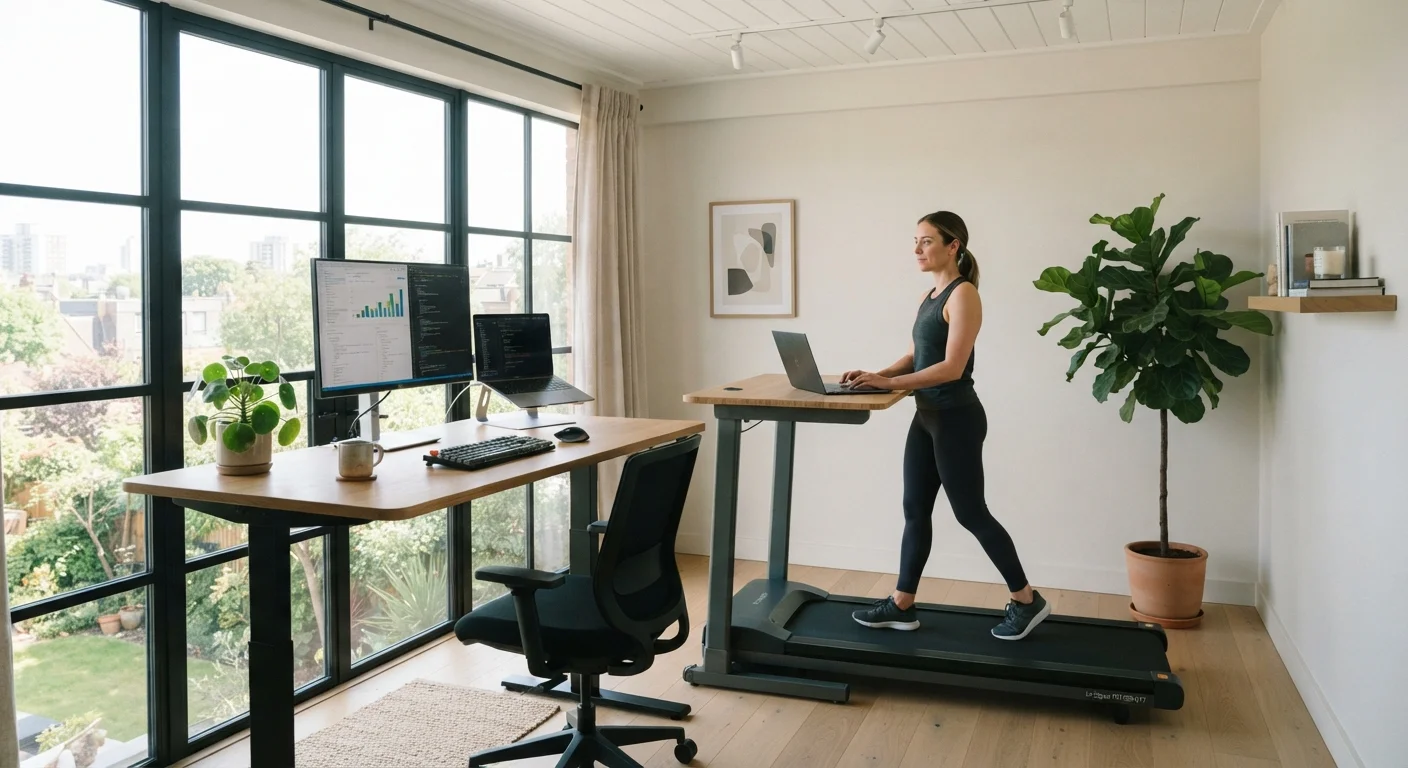
Photo credit: readerspanel.com
In this article
Standing and walking desks are marketed as antidotes to sedentary work. Here is a balanced look at what the evidence shows and what to realistically expect.
Key Takeaways
- Standing desks reduce continuous sitting time but do not replace structured exercise.
- Treadmill desks can meaningfully increase daily step count without requiring a gym visit.
- Both options carry real ergonomic and practical trade-offs that depend on your work type.
- Neither desk type has strong evidence for significant weight loss on its own.
- Alternating between sitting and standing is generally better than standing all day.
Reduces prolonged uninterrupted sitting time
Using a sit-stand desk consistently can cut two or more hours of daily sitting, which research associates with lower cardiovascular risk compared to all-day seated work.
Treadmill desks increase daily step count noticeably
Walking at slow speeds during work hours can add 3,000 to 5,000 steps to a person's daily total without requiring any additional time outside of work.
May ease lower back discomfort for some users
Some users report less lumbar stiffness when they alternate sitting and standing, particularly if they have a well-adjusted workstation and use an anti-fatigue mat.
Supports light calorie expenditure throughout the day
Treadmill desks in particular raise energy expenditure above resting levels for several hours at a time, contributing modestly to overall daily calorie burn.
Flexible for different work types
Sit-stand desks allow workers to switch positions based on the task, sitting for focused writing and standing for calls or reading, giving users control over their posture throughout the day.
Standing all day causes its own physical strain
Prolonged static standing is associated with leg fatigue, varicose vein risk, and lower back pain. Health professionals generally recommend alternating between sitting and standing rather than eliminating sitting entirely.
Treadmill desks can reduce cognitive task performance
Multiple studies have found that walking while working decreases accuracy on tasks requiring fine motor control or complex reasoning, which matters for knowledge workers.
High upfront cost for quality equipment
Motorized sit-stand desks range from a few hundred to over a thousand dollars, and treadmill desk setups can cost considerably more, making them inaccessible for many workers.
Noise and space requirements limit practical use
Treadmill desks generate motor noise that can disrupt video calls or shared office environments, and they require significant floor space that many home offices lack.
Benefits depend on correct ergonomic setup
Monitor height, keyboard position, and mat selection all affect whether the desk helps or causes new discomfort. Without proper adjustment, users may trade one physical complaint for another.
Not a substitute for structured physical activity
Neither standing nor slow walking meets the intensity threshold that guidelines associate with cardiovascular fitness gains, meaning regular exercise outside of work hours remains necessary.
What the research actually shows
The appeal of active workstations is straightforward: most American adults sit for eight or more hours on workdays, and prolonged sitting is associated with higher risk of cardiovascular disease, type 2 diabetes, and musculoskeletal discomfort, according to research published in journals including the American Journal of Epidemiology. Standing and treadmill desks are marketed as a fix for this, but the evidence is more nuanced than the advertising suggests.
Studies on standing desks generally find that they reduce sitting time by one to two hours per workday when used consistently. That is a meaningful change. However, simply standing does not raise heart rate or energy expenditure much above sitting. A 2018 review in the Cochrane Database of Systematic Reviews found that sit-stand desks reduced sitting time in the short term, with less certainty about longer-term effects or health outcomes.
Treadmill desks do more. Walking at low speeds (typically 1 to 2 mph) while working increases calorie burn and step count measurably. Some controlled studies have found improvements in blood pressure, waist circumference, and mood with consistent treadmill desk use over several months. The tradeoffs in cognitive performance and typing accuracy are addressed below.
This article is for general informational purposes only and is not medical advice. Consult a qualified healthcare professional before making changes that may affect a health condition.
Pros of standing and treadmill desks
Both desk types have documented benefits, though some are stronger for the treadmill version and others apply to both.
Reduces prolonged uninterrupted sitting time
Using a sit-stand desk consistently can cut two or more hours of daily sitting, which research associates with lower cardiovascular risk compared to all-day seated work.
Treadmill desks increase daily step count noticeably
Walking at slow speeds during work hours can add 3,000 to 5,000 steps to a person's daily total without requiring any additional time outside of work.
May ease lower back discomfort for some users
Some users report less lumbar stiffness when they alternate sitting and standing, particularly if they have a well-adjusted workstation and use an anti-fatigue mat.
Supports light calorie expenditure throughout the day
Treadmill desks in particular raise energy expenditure above resting levels for several hours at a time, contributing modestly to overall daily calorie burn.
Flexible for different work types
Sit-stand desks allow workers to switch positions based on the task, sitting for focused writing and standing for calls or reading, giving users control over their posture throughout the day.
For people whose jobs involve mostly email, meetings, or reading, even walking at 1 mph can accumulate thousands of additional steps without requiring a separate workout. See our overview of what daily step count does for the body for context on why those steps add up.
Cons and real-world limitations
The downsides are practical and worth taking seriously before spending several hundred to several thousand dollars on equipment.
Standing all day causes its own physical strain
Prolonged static standing is associated with leg fatigue, varicose vein risk, and lower back pain. Health professionals generally recommend alternating between sitting and standing rather than eliminating sitting entirely.
Treadmill desks can reduce cognitive task performance
Multiple studies have found that walking while working decreases accuracy on tasks requiring fine motor control or complex reasoning, which matters for knowledge workers.
High upfront cost for quality equipment
Motorized sit-stand desks range from a few hundred to over a thousand dollars, and treadmill desk setups can cost considerably more, making them inaccessible for many workers.
Noise and space requirements limit practical use
Treadmill desks generate motor noise that can disrupt video calls or shared office environments, and they require significant floor space that many home offices lack.
Benefits depend on correct ergonomic setup
Monitor height, keyboard position, and mat selection all affect whether the desk helps or causes new discomfort. Without proper adjustment, users may trade one physical complaint for another.
Not a substitute for structured physical activity
Neither standing nor slow walking meets the intensity threshold that guidelines associate with cardiovascular fitness gains, meaning regular exercise outside of work hours remains necessary.
People who try to stand all day often end up with sore feet, tight calves, or lower back pain, particularly if they do not have a quality anti-fatigue mat and properly adjusted monitor height. The same logic applies to treadmill desks: poor posture while walking can create new discomfort rather than relieving existing tension.
If your work involves detailed writing, complex spreadsheets, or video calls requiring concentration, a treadmill desk may frustrate more than it helps. Simpler movement strategies for desk workers can be a more accessible starting point for many people.
Setting realistic expectations
Neither desk type is a weight-loss tool in any meaningful sense. A person walking at 1.5 mph burns roughly 100 to 130 more calories per hour than sitting, and that estimate depends heavily on body weight and walking efficiency. Over weeks and months, that can contribute to an overall active lifestyle, but it will not compensate for an otherwise sedentary or poor diet pattern on its own.
Alternating beats extremes
Occupational health researchers generally advise against both all-day sitting and all-day standing. A pattern of roughly 30 minutes sitting followed by 30 minutes standing is a common starting recommendation, adjusted based on personal comfort and task demands. If you have an existing musculoskeletal condition, check with a healthcare provider before changing your workstation setup significantly.
The strongest use case for both standing and treadmill desks is interrupting continuous sedentary time rather than replacing deliberate exercise. Brief structured workouts and everyday physical activity still matter alongside whatever desk setup you choose.
If you are considering either option, a few practical steps help: try a standing desk converter before committing to a full setup, spend the first two weeks alternating 30 minutes sitting with 30 minutes standing rather than standing all day, and assess whether your specific work tasks are compatible with walking before investing in a treadmill unit.

Author
Health & Wellness Editorial Team
Health & Wellness Editorial Team is the collective byline for our editorial team and contributor network. Articles published under this byline or an editorial pen name are researched, written, and reviewed according to our editorial standards for clarity, consistency, and independence before publication.
View all articles →