
What Homeowners Get Wrong About Wood Filler and Spackling Paste
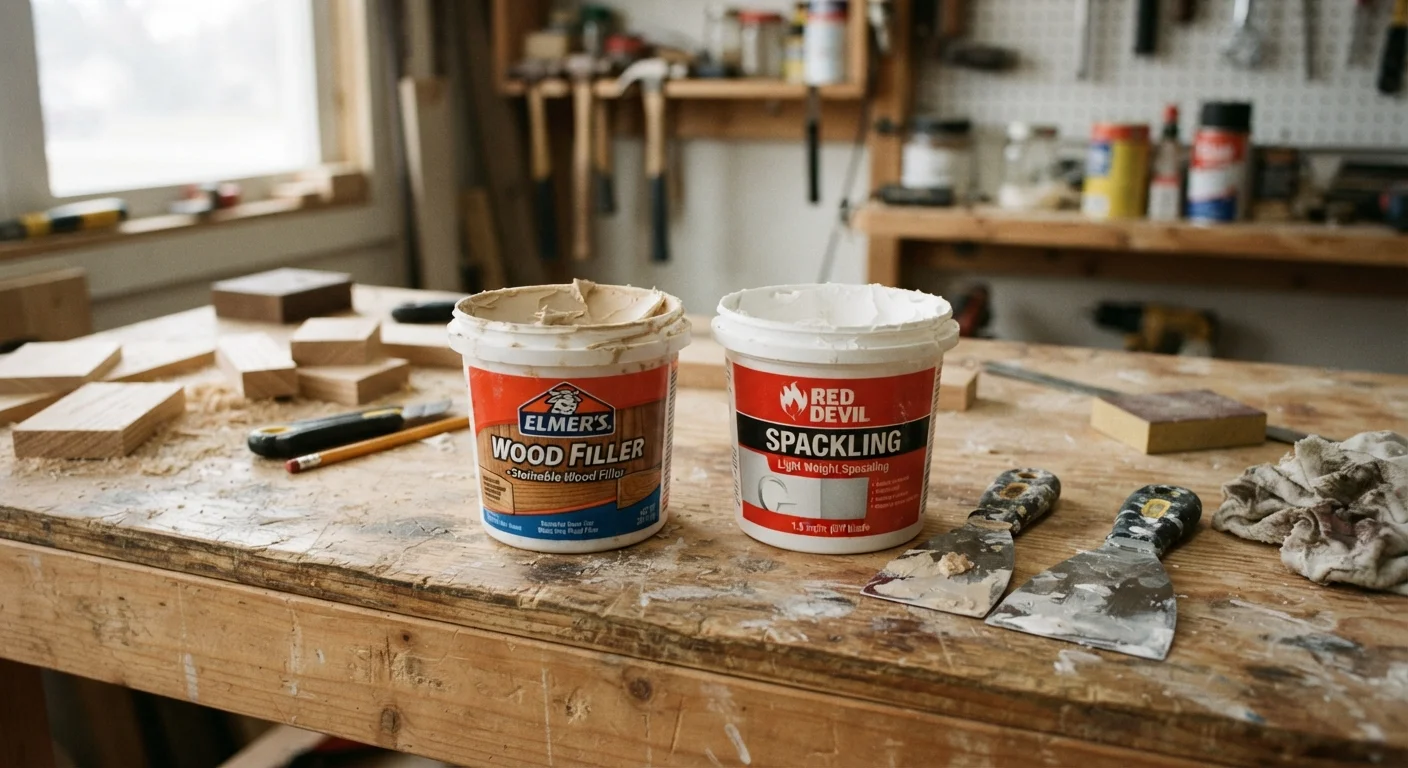
Photo credit: readerspanel.com
In this article
Using spackling on wood or wood filler on walls leads to cracking and re-repair. Understand what each product is actually designed to do.
Key Takeaways
- Wood filler bonds to wood fibers and can be sanded, shaped, and stained; spackling cannot.
- Spackling paste is designed for plaster and drywall, not for porous wood surfaces.
- Using the wrong product typically results in cracking, shrinkage, or paint adhesion failure.
- Most wood fillers require a primer coat before painting; spackling is usually paint-ready quickly.
- Two-part epoxy wood fillers work best for exterior or load-bearing repairs where flexibility matters.
Why the confusion keeps happening
Both products come in small tubs, spread with a putty knife, and dry to a paintable surface. That visual similarity is enough to send many homeowners reaching for whichever container is already on the shelf. The problem is that the formulas are built around different substrates, and each one fails when it meets the wrong material.
If you have ever patched a nail hole in a baseboard with spackling, let it dry, sanded it smooth, and then watched it crack and fall out within a season, that is the mismatch in action. The same outcome happens in reverse: wood filler applied to a drywall seam tends to shrink unevenly and resist the feathering required for an invisible finish. Getting the right product for the job is covered in more depth in our beginner's repair guide, which walks through essential tools and first projects for new homeowners.
Common myths about wood filler and spackling
The misconceptions below are the ones that cause the most re-work in home repair. Each one has a concrete correction and a plain explanation of the chemistry or mechanics behind it.
Myth
Wood filler and spackling are interchangeable for small holes, so it does not matter which one you use.
Fact
They are chemically different products. Wood filler bonds to wood grain; spackling is formulated for gypsum-based surfaces and does not adhere reliably to wood over time.
Spackling paste is primarily a gypsum or vinyl compound suspended in water. On drywall, it grips the paper face and the gypsum core well. On bare wood, it sits on the surface without penetrating the grain, which means movement in the wood, even minor seasonal expansion, breaks the bond. The result is a patch that cracks, pops out, or crumbles at the edges within months. Wood filler contains binders, and in the case of solvent-based products, resins that soak into the surrounding fibers and create a mechanical grip. That grip is what allows wood filler to hold through the movement that wood naturally undergoes.
Myth
You can use wood filler on drywall because it is stronger than spackling.
Fact
Strength is not the issue. Wood filler does not feather well on flat drywall surfaces and can shrink in a way that creates a visible ridge once painted.
Drywall finishing requires a compound that spreads thin at the edges and blends almost invisibly into the surrounding surface. Spackling and joint compound are formulated to do exactly that. Wood fillers, particularly solvent-based ones, are stiffer and do not spread to a true feathered edge. When the filler shrinks as the solvent evaporates, the center pulls down while the edges may stay slightly raised, leaving a detectable bump under paint. For a drywall repair to disappear visually, the patch needs to be flush and the texture needs to match. Wood filler makes both tasks harder, not easier.
Myth
All wood fillers can be stained to match the surrounding wood.
Fact
Only certain wood fillers accept stain predictably. Many water-based fillers do not absorb stain the same way raw wood does, and the patch may appear lighter or as a flat spot.
Wood absorbs stain through its pores and grain structure. A filler that does not have a similar porous structure will either reject the stain almost entirely or absorb it at a different rate, producing a color that does not match. Some manufacturers produce stainable wood fillers that include fine wood particles and are designed to accept stain, but they still benefit from testing on scrap material first. For structural or visible repairs on stained wood furniture, a tinted wax stick or a blended filler mixed with sawdust from the same species can produce a closer match than any off-the-shelf filler applied without preparation.
Myth
Spackling can fill deep holes in one application if you press it in firmly enough.
Fact
Spackling shrinks as it dries. Deep fills require multiple thin layers, each dried fully before the next, or the center will sink and crack.
Lightweight spackling dries by water evaporation, and as that water leaves the compound, the volume decreases. A shallow nail-hole fill of roughly 1/8 inch or less dries with little visible shrinkage. A deeper hole packed in a single pass will show a sunken center once dry, sometimes a crack radiating from the middle. The correct approach for holes deeper than about 1/4 inch is to apply the material in layers no thicker than 1/8 inch, letting each coat dry completely before adding the next. For very deep voids in plaster, a setting compound that hardens by chemical reaction rather than evaporation is a more stable choice because it does not shrink as it cures.
Myth
Once the filler is dry and sanded, no primer is needed before painting.
Fact
Both wood filler and spackling are more porous than the surrounding surface and will absorb paint unevenly without a primer coat.
An unprimed patch will often appear as a dull or shiny spot under the final paint coat because the filler absorbs the paint at a different rate than the surrounding material. This is called flashing, and it is particularly visible at certain lighting angles. A coat of primer seals the patch, creates a uniform surface for the topcoat, and prevents the filler from pulling moisture out of the paint, which can cause adhesion problems. On wood, a shellac-based or oil-based primer is preferred when working over solvent-based fillers. On drywall, a standard PVA drywall primer is sufficient for spackling repairs.
How to choose correctly before you open any container
The fastest check is to look at the substrate. If the surface is wood, choose a product labeled specifically as wood filler or wood putty, and read whether it is solvent-based or water-based. Solvent-based fillers tend to shrink less and accept stain more evenly, which matters when the finished surface will be natural wood rather than painted. Water-based fillers are easier to clean up and workable for painted wood. For exterior wood, a two-part epoxy filler is the appropriate choice because it does not absorb moisture and does not expand or contract with seasonal temperature changes.
If the surface is drywall or plaster, reach for spackling. Lightweight spackling is well suited to small nail holes and dings. For larger voids or cracks in plaster walls, a setting-type joint compound cures by chemical reaction rather than drying by evaporation, which makes it more durable and less prone to cracking under a full paint coat. It also requires more sanding than lightweight spackling.
Color matching is a separate consideration from product selection. Neither wood filler nor spackling is invisible under a clear finish, so if you are working on stained wood, test the filler on scrap or in an inconspicuous spot before committing. For wood that will be painted, color matching matters less, but sanding the filler flush before priming is still necessary for a flat surface. Curious about how wood tones interact with décor choices more broadly? Our article on mixing wood tones at home covers the principles behind intentional material layering.
Do not use interior wood filler on exterior surfaces
Interior-grade wood fillers are not formulated to handle freeze-thaw cycles, direct rain exposure, or prolonged UV light. Applied outside, they absorb moisture, swell, and can cause the surrounding wood to split. For any exterior wood repair, look for a product specifically labeled for exterior use or select a two-part epoxy filler, which does not absorb water.

Author
Home & Garden Editorial Team
Home & Garden Editorial Team is the collective byline for our editorial team and contributor network. Articles published under this byline or an editorial pen name are researched, written, and reviewed according to our editorial standards for clarity, consistency, and independence before publication.
View all articles →