
Why Dogs Pull on the Leash and What's Actually Going On in Their Heads
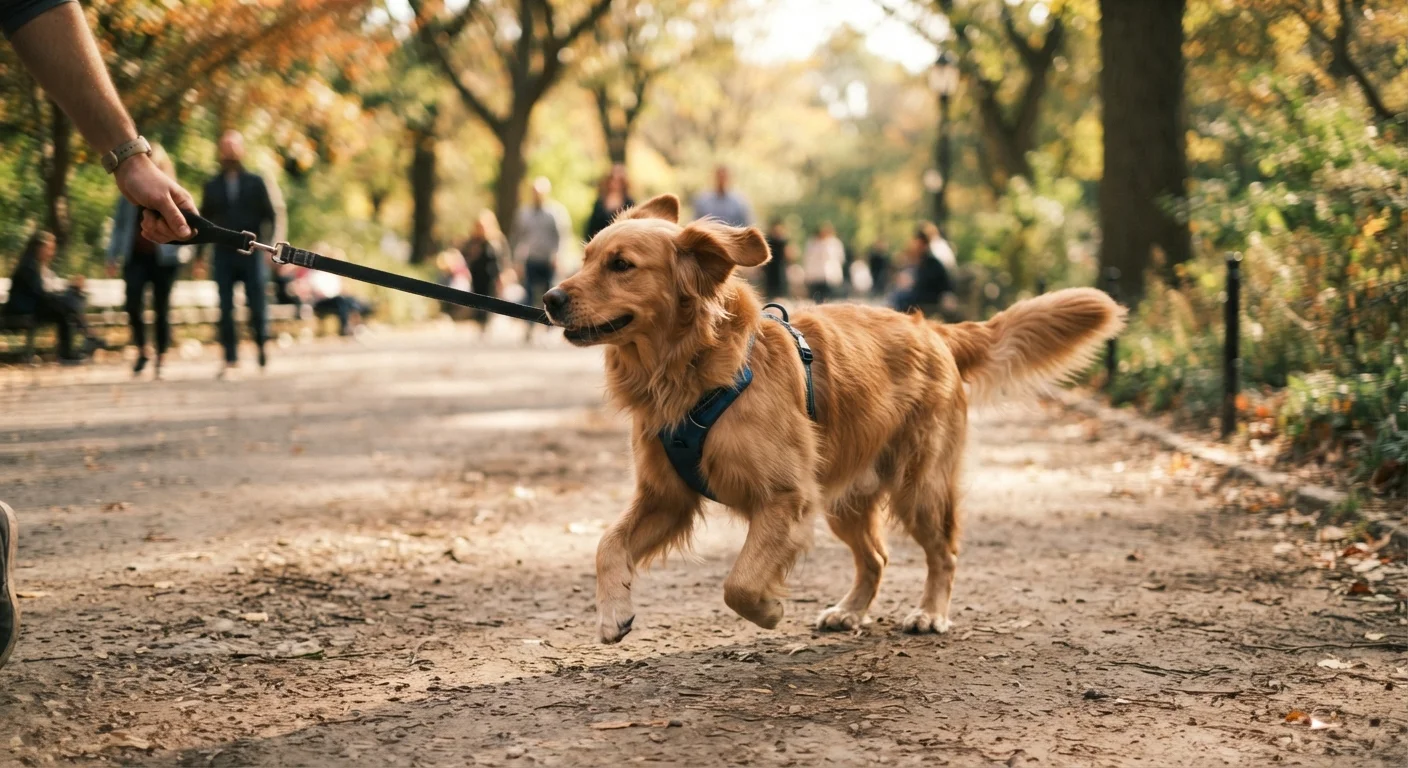
Photo credit: readerspanel.com
In this article
Leash pulling isn't stubbornness. Learn what motivates the behavior and the principles behind teaching your dog to walk calmly beside you.
Key Takeaways
- Dogs pull because moving forward has always worked for them, not because they are being stubborn or dominant.
- A dog's natural walking pace and sensory curiosity are much greater than most humans move on a walk.
- The leash itself teaches nothing about where to walk; the dog needs explicit guidance to understand what position earns forward movement.
- Consistent reinforcement of loose-leash moments is more effective than corrections after tension appears.
- Pulling behavior can be reshaped at any age with patient, clear communication.
The simple reason dogs pull
Dogs pull on the leash because it works. Every time a dog leans into the leash and moves forward, it gets closer to whatever it wants: a fire hydrant, a squirrel, another dog, a patch of interesting grass. From the dog's perspective, applying pressure to the leash is a successful strategy, and successful strategies get repeated.
This is not a character flaw. Dogs have no instinct that tells them to walk at a human pace or stay at a person's side. Loose-leash walking is an entirely learned skill, and most dogs are never taught it clearly. Puppies get put on leashes and walked before any instruction has happened, so pulling becomes the default from day one.
The behavior also accelerates because owners often, without realizing it, reward it. When a dog pulls toward something and the owner eventually walks that direction, the dog has just learned that pulling harder produces results. Even an occasional payoff is enough to keep the behavior strong.
What the walk feels like from inside the dog's head
A walk outside is one of the most sensory-rich experiences a dog has. Smell, above all else, drives a dog's experience of the world. A single patch of sidewalk can carry information about dozens of animals, people, and events. Dogs process this information at a much higher level of detail than humans do through vision, and they are drawn to investigate it urgently.
Add to that a dog's natural trot pace, which is considerably faster than a relaxed human walk, and the tension in the leash makes sense. The dog is not trying to escape or challenge anyone. It is simply moving at the speed its body prefers toward the stimuli its brain finds compelling.
Understanding this reframes the training task. The goal is not to suppress a dog's curiosity or force it to ignore the world. It is to teach the dog that staying close to you is worth doing, because good things happen there too.
Start training before the walk begins
A dog that is already excited at the door is harder to work with than one that has been asked to sit and settle first. Practicing calm departures, asking for a sit before the leash goes on, and waiting for the dog to relax before opening the door all reduce the arousal level the dog brings to the walk itself.
Why corrections alone rarely solve it
Yanking back on a leash, saying a sharp "no," or stopping abruptly can interrupt a pull in the moment. But without teaching the dog what to do instead, corrections leave a gap. The dog does not learn "walk here beside me"; it learns "pulling sometimes causes an unpleasant thing." In a stimulating environment, the pull toward something interesting can easily outweigh that mild deterrent.
There is also a timing problem. By the time a dog is already pulling hard, it is already somewhat aroused and focused on its target. That is a difficult moment to teach anything. Training is far more effective when it starts before tension appears, reinforcing the dog for being in the right position before it has a chance to drift forward.
Impulse control exercises address this gap directly. They build a dog's ability to pause and check in rather than react immediately to whatever is in the environment, which is exactly the mental skill loose-leash walking requires.
The principle behind teaching a loose leash
The core idea is simple: forward movement is the reward, and it only happens when the leash is loose. The moment the leash goes tight, forward movement stops. The moment the dog returns to a neutral position and the leash goes slack, movement resumes. Done consistently, the dog learns that a loose leash is the condition under which walks happen.
Combining this with positive reinforcement for the dog actively choosing to be near you makes the behavior stronger. A dog that finds staying close genuinely rewarding, through food, play, or praise delivered at the right moment, will offer that behavior more often. The dog is not just tolerating the rule; it is choosing the behavior because the behavior pays off.
Consistency across all handlers matters too. If the dog pulls freely with one family member but is asked to walk politely with another, progress stalls. Everyone who walks the dog needs to apply the same expectations.
This article is for general informational purposes and is not a substitute for guidance from a certified professional dog trainer or veterinary behaviorist, particularly for dogs with fear, reactivity, or aggression on leash.
Frequently Asked Questions

Author
Pets & Animals Editorial Team
Pets & Animals Editorial Team is the collective byline for our editorial team and contributor network. Articles published under this byline or an editorial pen name are researched, written, and reviewed according to our editorial standards for clarity, consistency, and independence before publication.
View all articles →