
Front-Wheel, Rear-Wheel, and All-Wheel Drive: How Drivetrain Layout Changes Your Maintenance Needs
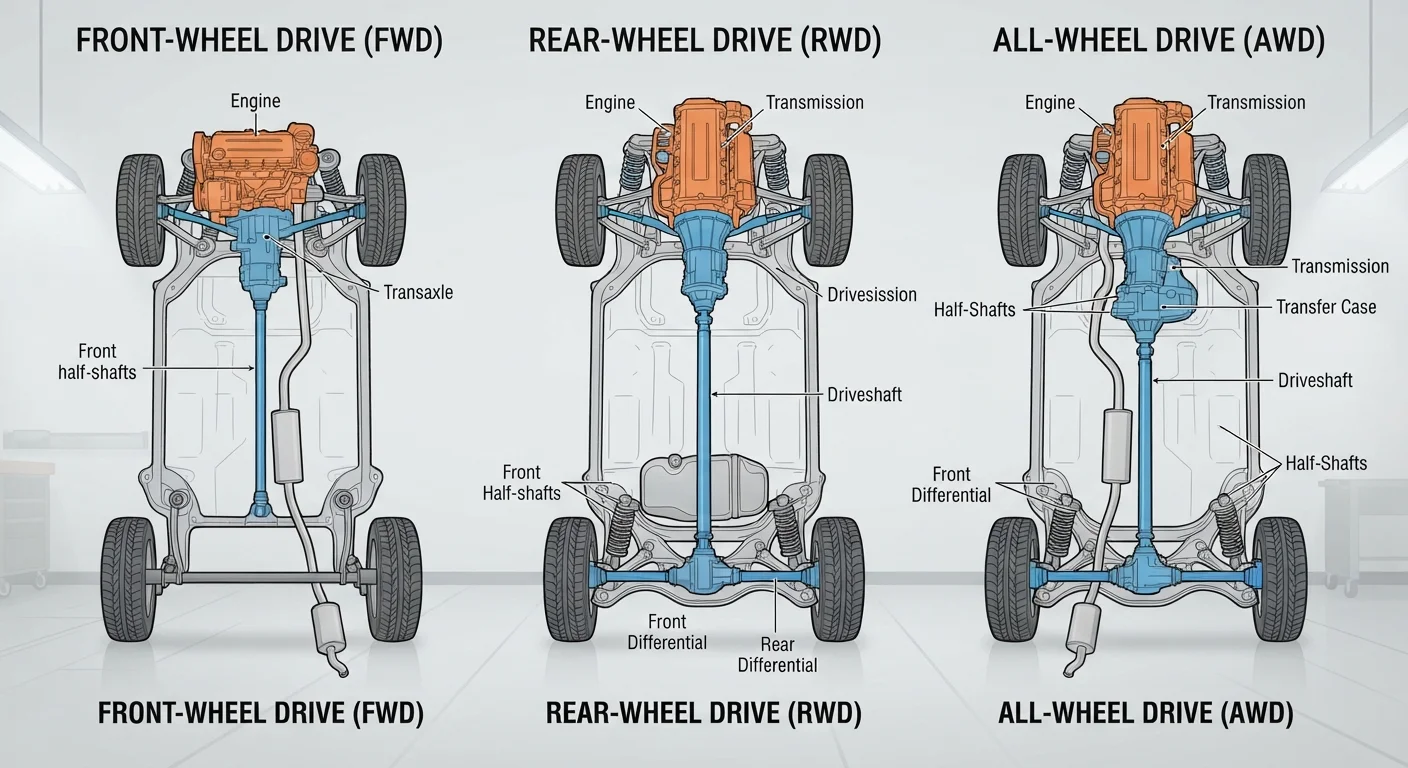
Photo credit: readerspanel.com
In this article
Your car's drivetrain affects which components need servicing and how often. Here is what changes depending on whether you drive FWD, RWD, or AWD.
Key Takeaways
- FWD vehicles concentrate wear on the front axle, making CV axle and front tire maintenance more frequent.
- RWD vehicles require differential and driveshaft attention that FWD owners never deal with.
- AWD systems add transfer cases and extra differentials, raising both fluid change frequency and overall service complexity.
- Tire rotation patterns differ by drivetrain type, so a one-size-fits-all approach can accelerate uneven wear.
- Your owner's manual specifies drivetrain-specific fluid intervals that generic service reminders often miss.
How drivetrain layout shapes your service schedule
The drivetrain determines which wheels receive engine power and how that power gets there. That mechanical path creates specific components, and those components need periodic service. Front-wheel drive (FWD), rear-wheel drive (RWD), and all-wheel drive (AWD) each have a distinct set of service items that owners should track alongside standard oil changes and brake inspections.
Generic mileage reminders from a quick-lube shop often do not account for these differences. Your owner's manual lists the intervals and fluid specifications that apply specifically to your vehicle's drivetrain, and those figures are the ones that matter.
| FWD | RWD | AWD | |
|---|---|---|---|
| Unique service items | CV axle boots and joints | Rear differential, U-joints | Transfer case, front and rear differentials |
| Tire wear pattern | Front tires wear faster | Rear tires wear faster | All four must stay closely matched |
| Fluid change complexity | Transaxle fluid only | Differential gear oil | Transfer case plus multiple differential fluids |
| Overall maintenance cost | Lower | Moderate | Higher |
| Rotation pattern sensitivity | Moderate | Moderate | High (tire diameter matters) |
| Driveshaft present | No | Yes | Yes (front and rear) |
Front-wheel drive: front-heavy wear patterns
In a FWD vehicle, the front axle does three jobs at once: it steers, it drives, and it carries most of the engine's weight. That combination concentrates wear on the front tires and on the constant-velocity (CV) axles that transfer power through the steering angles.
CV axle boots, the rubber covers that keep grease around the CV joints, crack over time and let in dirt. A torn boot accelerates joint wear significantly. Inspecting the boots during oil changes costs nothing and can prevent a much more expensive axle replacement. Most CV joints themselves last well beyond 100,000 miles if the boot stays intact, but they degrade faster on vehicles driven on rough roads or subjected to hard cornering.
Tire rotation is more critical on FWD vehicles because the front tires wear faster than the rear. A front-to-rear rotation pattern every 5,000 to 7,500 miles (or as your manual specifies) helps even out that wear. Uneven wear patterns on FWD vehicles often indicate delayed rotations, low tire pressure, or alignment issues.
FWD vehicles have a single transaxle that combines the transmission and differential in one unit. The fluid in that unit needs periodic inspection and replacement per the manufacturer's schedule, though the interval varies widely by vehicle.
Rear-wheel drive: distributed load, added components
RWD layouts send power rearward through a driveshaft to a rear differential, which then splits power between the two rear wheels. The front wheels handle only steering, which reduces front tire wear compared to FWD. The tradeoff is a set of service items that FWD owners never encounter.
The rear differential contains gear oil that breaks down over time. Most manufacturers call for inspection and fluid change somewhere between 30,000 and 60,000 miles, but towing, hauling, or frequent stop-and-go driving can shorten that interval. Neglected differential fluid leads to gear wear and, eventually, differential failure, which is a costly repair.
The driveshaft on most RWD vehicles has universal joints (U-joints) that allow the shaft to flex as the suspension moves. Some U-joints have grease fittings and require periodic lubrication; others are sealed for life. A worn U-joint produces a clunking sensation during acceleration or a vibration at highway speeds. Catching it early typically means a straightforward replacement; ignoring it can damage the transmission output shaft or the differential.
Because rear tires on RWD vehicles do the driving work, they wear faster than the fronts. Rotation intervals and patterns should account for this, and rotation, balancing, and alignment each play a distinct role in keeping wear even across all four tires.
All-wheel drive: more capability, more to maintain
AWD systems add a transfer case and, on most designs, front and rear differentials. Some AWD vehicles use an electronically controlled coupling instead of a traditional center differential, but all of them have more fluid-filled components than FWD or RWD vehicles.
Transfer case fluid is often overlooked because the transfer case has no obvious warning light and no common service interval reminder from generic maintenance shops. The manufacturer interval varies, but many fall in the 30,000 to 60,000 mile range. Skipping this fluid change degrades the internal clutch packs or gears that manage torque distribution between the front and rear axles.
AWD vehicles are also sensitive to tire diameter mismatches. If one tire is significantly more worn than the others, the system may interpret the speed difference as wheel slip and engage or disengage unnecessarily, stressing the coupling or transfer case. This makes consistent tire rotation and prompt replacement of worn tires more important on AWD vehicles than on FWD or RWD. Simple between-visit habits, like checking tire pressure and tread depth monthly, reduce that risk at no cost.
The total maintenance expense for AWD is genuinely higher. More fluids, more intervals, and more components to inspect add up over time. Staying current on routine maintenance matters more on AWD vehicles precisely because deferred service tends to cascade across interconnected drivetrain components.
Practical steps regardless of which drivetrain you have
Every drivetrain type benefits from the same foundational habits. Check all fluids (including transmission and differential where applicable) at every oil change interval, not just the ones a quick-lube receipt mentions. Follow the rotation schedule in your owner's manual rather than a generic mileage number, and use the rotation pattern appropriate to your drivetrain layout.
Listen for changes. A new vibration, a clunk on acceleration, or a whine from the rear of the vehicle are worth investigating promptly. These sounds usually point to drivetrain components at an early stage of wear, when repair costs are lower. Understanding the real costs of car ownership starts with recognizing that a $50 fluid change prevents repairs that can run into the thousands.
This article is for general informational purposes only. Consult your vehicle's owner's manual and a qualified mechanic for service intervals and procedures specific to your vehicle.

Author
Automotive Life Editorial Team
Automotive Life Editorial Team is the collective byline for our editorial team and contributor network. Articles published under this byline or an editorial pen name are researched, written, and reviewed according to our editorial standards for clarity, consistency, and independence before publication.
View all articles →