
Roundabouts, Four-Way Stops, and Uncontrolled Intersections: Knowing Who Goes First
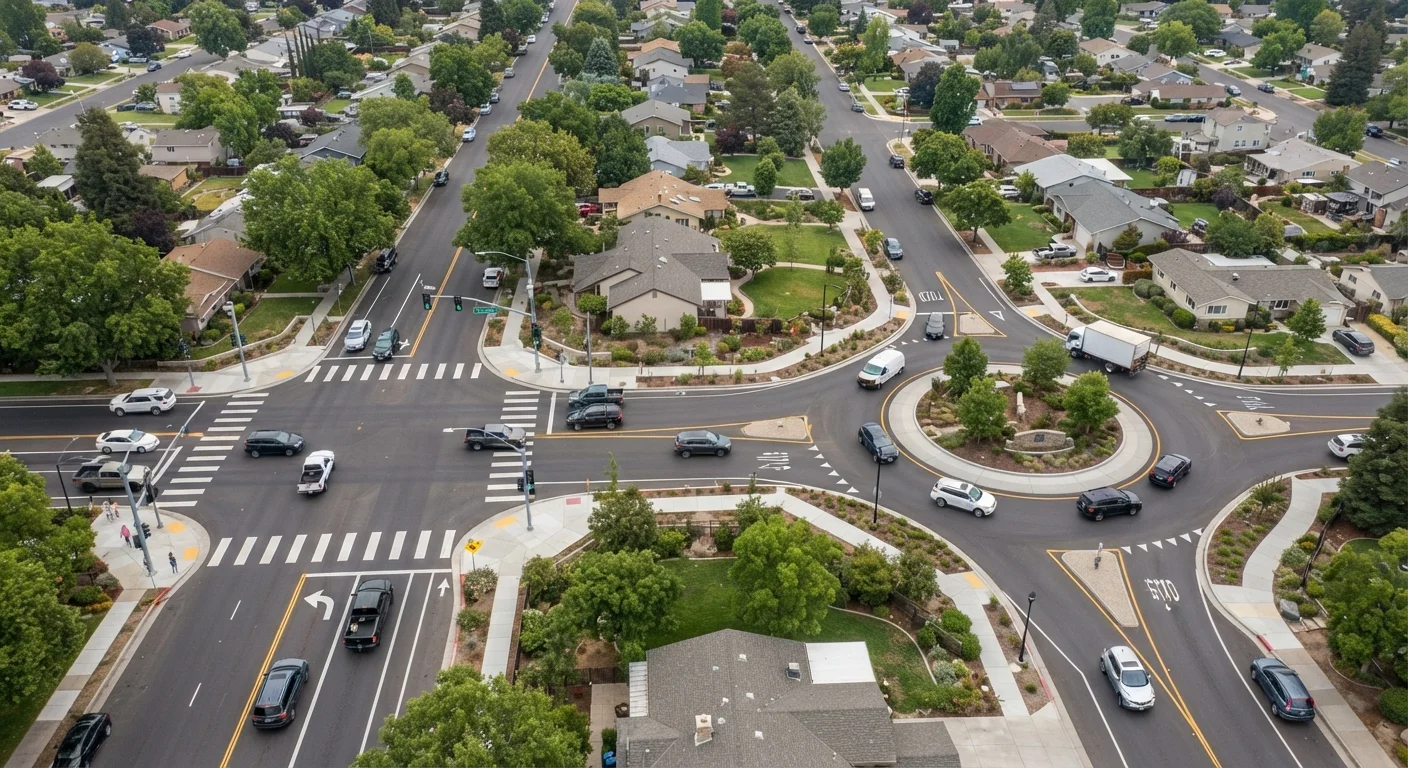
Photo credit: readerspanel.com
In this article
Intersection confusion causes thousands of collisions each year. A clear reference on right-of-way rules for the situations drivers find most uncertain.
Why intersection right-of-way trips up experienced drivers
Intersection collisions account for a substantial share of crashes on American roads each year, and many of them happen not because drivers were reckless but because they were uncertain. A driver who hesitates at a four-way stop, or who enters a roundabout without understanding the yield rule, creates a gap for conflict even at low speeds.
Right-of-way rules are not optional courtesies. They are codified in state traffic law, and while exact language varies by state, the underlying logic is consistent across the country. This reference covers the three intersection types that generate the most confusion: roundabouts, four-way stops, and uncontrolled intersections.
For drivers navigating dense city streets, where these situations can appear back to back, urban driving hazards that experienced drivers stop noticing covers how familiarity can quietly erode the habits that keep intersections safe.
| Four-way stop rule | First to arrive, first to go; tie broken by yielding to the right |
| Roundabout entry rule | Yield to all vehicles already circulating inside |
| Uncontrolled intersection default | Driver on the left yields to driver on the right (Reflects majority U.S. state traffic codes; verify your state's law) |
| Left-turn rule at any intersection | Turning left always yields to oncoming traffic going straight |
| Pedestrian priority | Pedestrians in a marked or unmarked crosswalk have the right of way (Applies in all 50 states; some states extend this to unmarked crosswalks) |
| Rolling stop | Not a legal stop; does not establish arrival order at a four-way stop |
Four-way stops: the arrival order rule and its exceptions
The core rule at a four-way stop is straightforward: the vehicle that arrives and comes to a complete stop first has the right of way and proceeds first. When two vehicles arrive at the same time, the driver on the left yields to the driver on the right. That means the vehicle to the right goes first.
Three common scenarios cause confusion:
- Simultaneous arrival on opposite sides. When two vehicles face each other and neither is turning, both may proceed at the same time because their paths do not cross. If one of them is turning left, that driver must yield to the oncoming vehicle going straight.
- Three or four vehicles arriving together. Priority goes to the rightmost vehicle. If the situation is still ambiguous, eye contact and a brief wait usually resolve it. No driver is obligated to go simply because another driver waves them through, since accepting that gesture does not transfer legal right of way.
- Incomplete stops. A rolling stop does not count as a legal stop and does not establish arrival order. Coming to a full stop behind the stop line is the legal baseline in every state.
New license holders often struggle with the simultaneous-arrival scenario. Teen driver safety gaps that classroom training tends to skip examines why pattern recognition at intersections takes real-world time to develop.
Roundabouts: yielding to circulating traffic
Roundabouts operate on a single governing rule: vehicles already inside the circle have the right of way. Entering drivers must yield, regardless of how long they have been waiting at the entry point.
The yield line at a roundabout entry is not a stop line. Drivers should slow and look left (because circulating traffic approaches from that direction in the U.S.), then enter only when there is a safe gap. Stopping unnecessarily when the circle is clear slows traffic without improving safety.
Lane selection in a multi-lane roundabout follows the same logic as a standard highway interchange. The right lane is for exits at roughly the first or second exit; the left lane is for exits further around the circle. Changing lanes inside a roundabout is prohibited and dangerous.
Pedestrian crosswalks at roundabout entries and exits carry the same legal weight as any marked crosswalk. Pedestrians have the right of way at those points, and entering or exiting drivers must yield to them before proceeding.
Roundabout design varies significantly. Some older traffic circles operate under different rules than modern yield-on-entry roundabouts, so reading posted signs at an unfamiliar circle is always worth a moment of attention.
Uncontrolled intersections: the default right-of-way
An uncontrolled intersection has no stop sign, yield sign, or traffic signal. They appear frequently in rural areas, older residential grids, and parking lot exits that meet public roads. Most drivers encounter them less often than signalized intersections, which is part of why they cause disproportionate confusion.
The default rule in most states is that the driver on the left yields to the driver on the right. This mirrors the four-way stop tie-breaker. The driver arriving on a through road (a road that continues in a straight line) generally has priority over a driver entering from a side street or driveway, though this depends on state law and the specific geometry.
Speed matters here more than at controlled intersections. At an uncontrolled crossing, neither driver has a signal or sign confirming who should go. Approaching at a speed that allows a full stop if needed is the only way to handle the ambiguity safely. The National Highway Traffic Safety Administration consistently notes that driver behavior at uncontrolled intersections is among the harder problems in traffic safety, because no infrastructure enforces compliance.
Aggressive driving and the assumption that another driver will yield is a documented factor in intersection crashes. Recognizing aggressive driving patterns covers how that assumption escalates into conflict and what de-escalation looks like in practice.
Driving habits built at intersections carry directly into highway environments. How your approach should shift between highway and city driving looks at how the mental framework changes when you move between those two contexts.

Author
Automotive Life Editorial Team
Automotive Life Editorial Team is the collective byline for our editorial team and contributor network. Articles published under this byline or an editorial pen name are researched, written, and reviewed according to our editorial standards for clarity, consistency, and independence before publication.
View all articles →