
Teen Drivers and New License Holders: The Safety Gaps No One Talks About
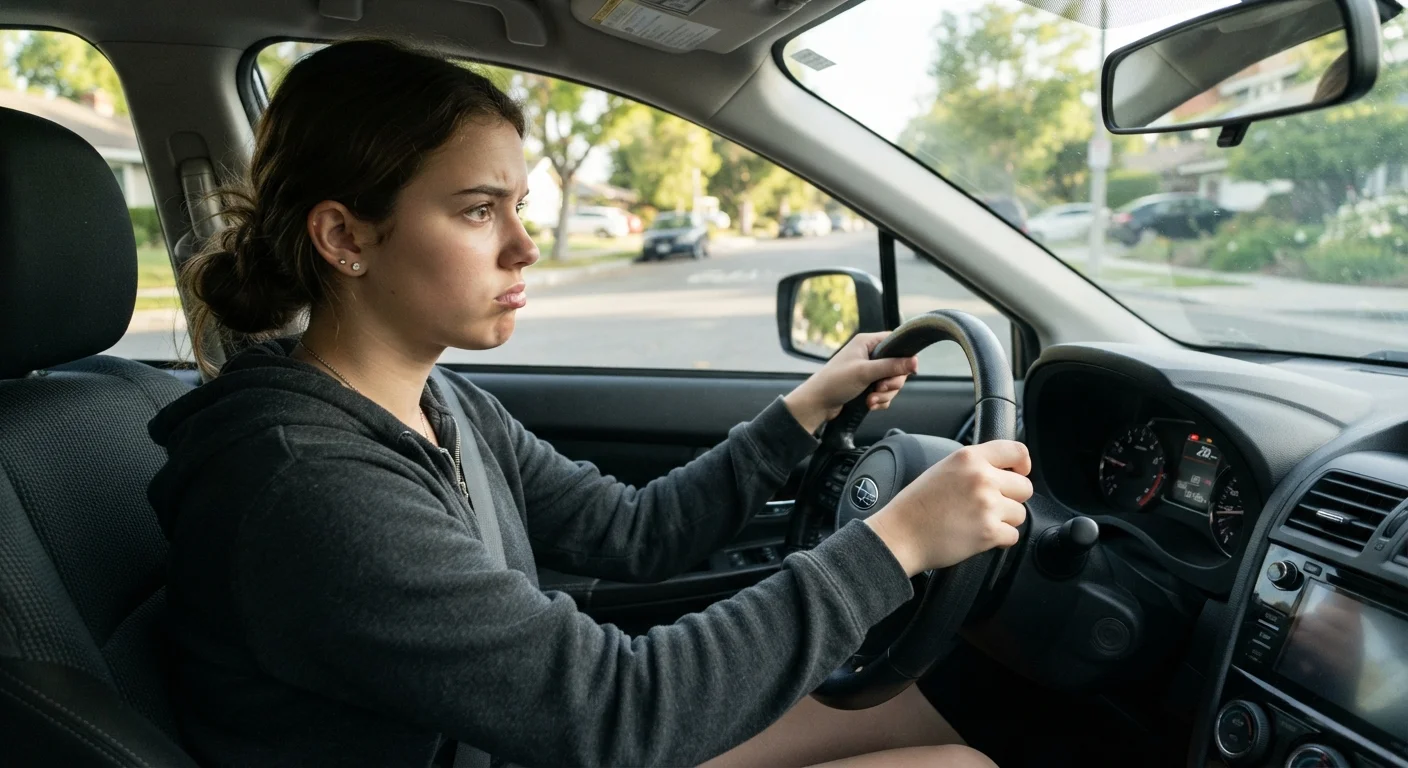
Photo credit: readerspanel.com
In this article
New drivers pass tests but still lack real-world pattern recognition. Explore the specific risk windows and skills that classroom training tends to skip.
Key Takeaways
- Teen drivers have the highest crash rate per mile driven of any age group, with risk peaking in the first six to twelve months after licensing.
- Standard driver education covers rules and basic vehicle control, but not the pattern recognition built through thousands of hours of real driving.
- Nighttime driving, highway merging, and carrying teen passengers each represent distinct, elevated risk situations for new drivers.
- Graduated Driver Licensing laws reduce teen crash deaths, but enforcement depends heavily on parents.
- Supervised practice that deliberately targets high-stress conditions closes more of the safety gap than hours alone.
Why new licenses don't equal road-ready
A new driver who passes a state road test has demonstrated that they can operate a vehicle according to a checklist. They can parallel park, signal lane changes, and yield at an intersection. What the test cannot measure is the pattern recognition that experienced drivers build over years: reading a driver two cars ahead for brake behavior, sensing when a pedestrian at the curb is about to step off, or processing a highway merge while monitoring blind spots simultaneously.
The gap between passing a test and being genuinely prepared for independent driving is widest right after licensing. According to the Insurance Institute for Highway Safety, crash rates per mile driven are highest for 16- and 17-year-olds, with the first six to twelve months after licensing carrying the greatest risk. That window matters because new drivers are often placed in real traffic conditions before their decision-making speed has caught up to the demands of those conditions.
Graduated Driver Licensing (GDL)
A staged licensing system that gives new drivers increasing privileges over time as they gain experience. It typically includes a learner's permit phase, a restricted provisional license, and then a full license.
Hazard anticipation
The ability to read road conditions ahead and predict potential dangers before they require an emergency response. Experienced drivers do this largely without thinking; new drivers have to build it deliberately.
Pattern recognition
The automatic, learned ability to interpret familiar situations quickly, such as recognizing that a vehicle slowing near a crosswalk probably means a pedestrian is crossing. It develops over thousands of hours of driving.
Provisional license
An intermediate stage in a graduated licensing program. A provisional license allows solo driving but typically includes restrictions such as passenger limits and nighttime driving curfews.
The risk windows that matter most
Three situations account for a disproportionate share of crashes among new drivers: nighttime driving, highway travel, and carrying teen passengers.
Nighttime dramatically reduces the hazard information available. A new driver who has mostly practiced in daylight has limited experience compensating for reduced depth perception and contrast. Many states restrict late-night driving under graduated licensing rules because the data on teen night crashes is consistent.
Highway driving introduces merging at speed, lane discipline across multiple lanes, and following distances that compress quickly. Most highway crashes cluster around lane changes, not cruising speed. New drivers who learned primarily on local roads often lack the spatial awareness and timing that merging demands.
Passengers change the social and attentional environment inside the vehicle. Teen passengers specifically increase crash risk for new drivers, with the risk rising as the number of passengers grows. Conversations, requests to change music, and peer expectations about speed all compete with the mental bandwidth that inexperienced driving still requires.
Skills the test doesn't measure
The standard driving exam was designed around a fixed set of observable actions. Several categories of skill that matter for real-world safety fall outside that frame.
Hazard anticipation is the ability to read upstream conditions: a stopped school bus with its lights not yet on, a ball rolling into the street, a driver in a parking lot who hasn't checked before pulling out. This is learned through repeated exposure, not from a test route.
Fatigue recognition is another gap. New drivers are often teens who are also sleep-deprived, and the impairment from drowsy driving mirrors alcohol-related impairment in ways most young drivers have never been told about explicitly.
Distraction management goes beyond phone use. Eating, in-car conversations, and mental preoccupation all degrade reaction time, and new drivers are less able to recover from attention lapses because they have fewer automatic driving behaviors to fall back on.
City-specific hazards also accumulate in ways that standard suburban test routes miss. Urban environments present patterns that even experienced drivers stop noticing, and new drivers entering dense traffic have no baseline for what to filter or what to watch.
How graduated licensing helps (and where it falls short)
All U.S. states have some form of Graduated Driver Licensing, or GDL. These programs introduce privileges in stages: a supervised learner's permit, then a provisional license with restrictions on passengers and nighttime hours, and eventually a full license. The Centers for Disease Control and Prevention has noted that stronger GDL laws are associated with reductions in teen driver fatalities.
The limits of GDL are practical rather than conceptual. Passenger restrictions are difficult to enforce outside the home, and many parents either don't know the specific rules in their state or choose not to enforce them consistently. Nighttime restrictions also vary widely by state, meaning a teen in one state faces meaningfully tighter limits than a peer in another.
Check your state's GDL rules before the test
State GDL laws differ significantly on passenger limits, nighttime curfews, and the minimum supervised hours required. Look up your state's Department of Motor Vehicles or equivalent agency for the current rules before the licensing exam, not after. Knowing the restrictions ahead of time makes enforcement more consistent.
What supervised practice should cover
Most state requirements set a minimum number of supervised hours, commonly between 40 and 65. Hours matter, but the variety of conditions covered during those hours matters more. A teen who completes 50 hours almost entirely in familiar neighborhoods in clear daytime weather is not as prepared as one who has practiced in rain, on highways, at night, and in unfamiliar areas.
Supervisors who plan practice sessions around deliberate exposure to harder conditions close more of the safety gap. That means highway entry and exit, shifting approach between highway and city driving, driving after dark, and navigating situations where following distance is tested. Talking through decisions in real time, rather than only correcting mistakes afterward, also builds the verbal framework teens can draw on when they're alone in the car.
Tailgating, both being caught behind an aggressive follower and resisting the urge to close gaps, is another skill worth practicing explicitly. Understanding the mechanics of tailgating and how to respond prepares a new driver for one of the more stressful and common situations they will encounter on their own.
Frequently Asked Questions

Author
Automotive Life Editorial Team
Automotive Life Editorial Team is the collective byline for our editorial team and contributor network. Articles published under this byline or an editorial pen name are researched, written, and reviewed according to our editorial standards for clarity, consistency, and independence before publication.
View all articles →